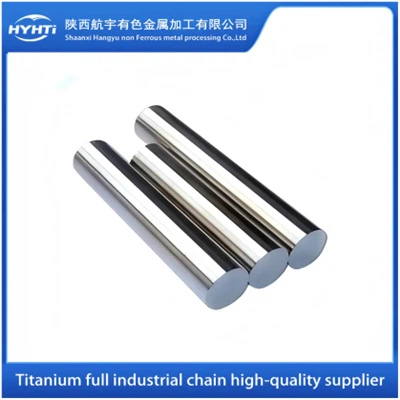
Product Introduction
Industrial pure titanium refers to non-alloy titanium with varying amounts of impurities such as Fe, C, O, and N. It has high plasticity, excellent forming process performance, and outstanding corrosion resistance. Due to its excellent overall properties, industrial pure titanium is used in various fields such as aerospace, ships, chemical industry, biomedicine, construction, and transportation. The long-term working temperature of industrial pure titanium is 300°C.
Material Standards
ASTM B348-13 Standard Specification for Titanium and Titanium Alloy Bars and Billets
Main Grades and Chemical Composition
Table 1 Chemical Composition of Industrial Pure Titanium
| Standard | Brand | bases | Impurity element | ||||
|
Ti |
Fe |
C |
N |
H |
O |
||
| ASTM B348-13 |
Gr.1 |
base |
0.20 |
0.08 |
0.03 |
0.015 |
0.18 |
|
Gr.2 |
base |
0.30 |
0.08 |
0.03 |
0.015 |
0.25 |
|
| Gr.2H | base | 0.30 | 0.08 | 0.03 | 0.015 | 0.25 | |
| Gr.3 | base | 0.30 | 0.08 | 0.05 | 0.015 | 0.35 | |
|
Gr.4
|
base |
0.50
|
0.08
|
0.05
|
0.015
|
0.40
|
|
Mechanical Properties
Table2 Mechanical Properties of Industrial Pure Titanium
|
Grade |
Tensile Strength, min |
Yield Strength (0.2 % Offset) min or range |
Elongation in 4D, min, % |
Reduction of Area,min % |
||
|
ksi |
MPa |
ksi |
MPa |
|||
|
1 |
35 |
240 |
20 |
138 |
24 |
30 |
|
2 |
50 |
345 |
40 |
275 |
20 |
30 |
|
2H |
58 |
400 |
40 |
275 |
20 |
30 |
|
3 |
65 |
450 |
55 |
380 |
18 |
30 |
| 4 | 80 | 550 | 70 | 483 | 15 | 25 |
Physical and Chemical Properties
Density: Approximately 4.51 g/cm³, only 60% that of steel, offering a significant weight advantage.
Melting Point: About 1660℃, with good high-temperature stability.
Thermal Conductivity: Relatively low, around 21-22 W/(m·K), and electrical conductivity is also low.
Corrosion Resistance: Industrial pure titanium rods exhibit good corrosion resistance in dilute sulfuric acid, hydrochloric acid, strong NaOH solutions, and seawater, with a lifespan 5-10 times that of stainless steel.
Processing Technology and Product Specifications
Typically, after hot forging and hot rolling, the material undergoes annealing (at temperatures between 900-1100°C) to relieve stress. Subsequent cold working can achieve high precision, with tolerances up to ±0.004mm, and after surface polishing, the surface finish can reach Ra0.4. The diameter of round bars usually ranges from 3 to 3500mm, and the length can be customized; square bars are available in cross-sections such as 6×6mm and 8×8mm.
Application Example
A push rod used for unloading a certain naval ship weapon consists of front, middle, and rear push rods. The three push rods have similar structures and comparable weights. Manual handling and positioning are required during installation. Originally, the push rods were made of stainless steel 0Cr-19Ni9, with the middle push rod weighing 27.2kg. After assembly, the total weight of the front, middle, and rear push rods was about 80kg. The heavy weight combined with limited space and manpower posed a significant challenge. After design improvement, the material was changed to titanium Gr.2, reducing the weight by approximately 2/5. For example, the middle push rod now uses two Φ65×100mm pieces and one Φ65×4.0×2700mm tube. After assembly, the total weight of the three push rods is about 48kg, making it more manageable.
Hot Tags: low-strength industrial pure titanium rod, China low-strength industrial pure titanium rod manufacturers, suppliers, factory