

Titanium alloys have the characteristics of high specific strength, good corrosion resistance and non-magnetism, and are widely used in aerospace, weapons and marine equipment. The micro-arc oxidation process is to form a ceramic film layer that grows in situ on the surface of the metal, and the resulting film layer has good bonding with the matrix and good corrosion resistance, so it has become a common surface modification technology for titanium and titanium alloys. The surface modification of titanium alloy is mainly to give it properties that it does not have originally, such as adding hard particles to the micro-arc oxide film layer to improve its wear resistance, and changing its appearance color by adding different coloring salts, see figure.
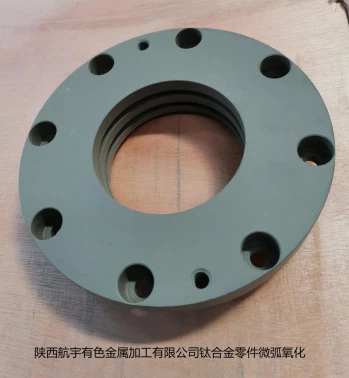
Due to its high oxidation voltage, micro-arc oxidation technology will form a spark discharge on the metal surface, through which a ceramic film layer is formed, and the structure of this ceramic film layer is dense in the inner layer and loose and porous in the outer layer. The wear resistance of the film layer can be improved by adding different additives and give it a certain decorative effect. On the one hand, the titanium alloy black micro-arc oxide film can achieve the role of a decorative film layer, and on the other hand, it can achieve the role of a functional film layer, such as the black micro-arc oxide film can play a certain protective role in the titanium alloy matrix, and the black film layer also has good matting properties, which can be used in optical instrument dials with its matting performance.
Although the micro-arc oxidation process has many advantages, it also has its own shortcomings, micro-arc oxidation is not applied to large-scale production due to the limitations of the operation process, mainly because the operation of micro-arc oxidation and ordinary electroplating and anodizing have many differences, and there are strict control requirements for the size and stability of voltage. The treated film layer is loose and porous structure, and the film layer is prone to adhesion wear when it experiences friction, and the surface of the film layer after friction is due to the shedding of the oxide film, the protective substance no longer exists, the porosity increases, and the corrosion resistance of the film becomes worse.


