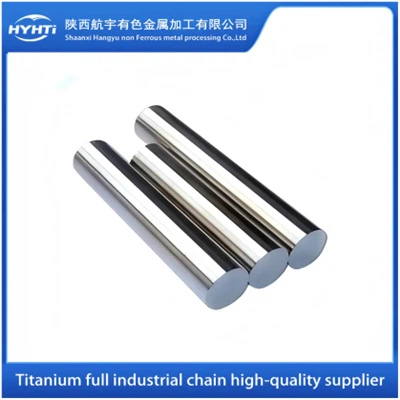
Product Introduction
TB2 is a metastable β-type titanium alloy that possesses excellent cold formability and welding performance in the solution-treated state, and shows a balance of high strength and good plasticity after solution aging.
Product parameters
1.Chemical elements are shown in Table 1.
|
Ingredient |
Mo |
V |
Cr |
Al |
Fe |
C |
N |
H |
O |
Ti |
|
Quality score% |
5.16 |
5.32 |
8.38 |
3.04 |
0.06 |
0.046 |
0.012 |
0.006 |
0.100 |
margin |
2.The mechanical properties at room temperature are shown in Table 2.
|
Qeat treatment condition |
Tensile strength(Rm/MPa) |
Yield strength(Rpo.2/MPa) |
Elongation after fracture(A/%) |
Reduction of area(Z/%) |
|
Untreated |
833 |
820 |
15.0 |
30.0 |
|
Untreated (horizontal) |
852 |
852 |
7.3 |
18.0 |
The mechanical properties of hot-rolled TB2 titanium alloy bars exhibit significant anisotropy under different conditions, particularly in plasticity indicators, where the transverse plasticity is much lower than that in the longitudinal direction. After solution treatment, the strength of the alloy decreases, while the plasticity indicators change little. This is because, during hot rolling, the temperature is high, and during the subsequent cooling process, recovery and recrystallization occur. Therefore, the effect of solution treatment after hot rolling on its properties is minimal. The TB2 alloy, due to the addition of alloying elements such as Mo and V that can form a continuous solid solution with titanium, as well as Al and Cr that can form compounds with titanium, exhibits a very significant aging strengthening effect.
3.The mechanical properties under different heat treatment conditions are shown in Table 3.
|
Heat treatment condition |
Tensile strength(Rm/MPa) |
Yield strength(Rpo. 2/MPa) |
Elongation after fracture(A/%) |
reduction of area(Z/%) |
|
710℃/30min AC |
833 |
825 |
14.5 |
27.2 |
|
790℃/30min AC |
800 |
800 |
14.2 |
34.3 |
|
710℃/30min AC+500℃/8h |
1290 |
1235 |
9.3 |
15.0 |
|
710℃/30min AC+520℃/8h |
1245 |
1220 |
11.3 |
28.0 |
|
710℃/30min WQ+500℃/8h |
1270 |
1213 |
6.3 |
7.7 |
|
710℃/30min WQ+520℃/8h |
1207 |
1150 |
7.8 |
8.6 |
|
790℃/30min AC+520℃/8h |
1200 |
1140 |
7.3 |
15.8 |
|
790℃/30min WQ+520℃/8h |
1227 |
1173 |
8.2 |
12.7 |
Application Fields
1. Aerospace fasteners: Suitable for aerospace fasteners (such as bolts and rivets) that work long-term below 300℃, can be used in solid solution or aging state, meeting the demands for high strength and lightweight.
2. Cold heading process can process complex-shaped bolts, suitable for key parts such as aircraft fuselage frames and wing beams.
3. Aerospace short-term high-temperature components: Can manufacture aerospace fasteners for short-term use below 500℃, such as rocket engine bay connectors.
4. Chemical and marine engineering: Pressure vessels, ship equipment components, etc.
5. Other industrial fields: High strength structural components, sporting equipment, etc.
Usage Precautions
1. Temperature Limitations: Long-term operating temperature should not exceed 300°C, otherwise, performance may decline due to high-temperature creep.
2. Processing Technology Adaptation: Hot processing should be conducted above 600°C to optimize microstructure uniformity, while cold processing should control deformation to avoid cracks, with recommended aging treatment (such as 520°C/8h) to balance strength and plasticity.
3. Material Limitations: The density is relatively high (approximately 4.8g/cm³), requiring a trade-off against lightweight requirements.
4. The elastic modulus (approximately 110GPa) is still higher than that of human bone, so careful evaluation is needed in the medical implant field.


Product Summary
TB2 titanium alloy rods play an important role in fields such as aerospace and marine chemical industries due to their high strength, excellent cold formability, and corrosion resistance. However, to fully realize their potential, close attention must be paid to their heat treatment procedures, working temperature limits, processing characteristics, and safety operating standards. Correct material selection, strict adherence to processes, and attention to safety are key to the successful application of TB2 titanium alloys. Choosing the right supplier becomes particularly important. Shaanxi Aerospace Nonferrous Metal Processing Co., Ltd. in China has a complete quality system and technical support, with a professional team providing rapid response and after-sales service to ensure that each titanium alloy rod consistently delivers outstanding performance throughout its entire lifecycle.
Hot Tags: tb2 titanium alloy rod, China tb2 titanium alloy rod manufacturers, suppliers, factory, titanium bar gr7, titanium bar price per kg, titanium alloy rod, Grade 4 Titanium Rod